This website uses cookies to analyze user experience and ads effectiveness. We use Google Analytics and Yandex.Metrica to collect anonymous information only if you allow us to do so by clicking "I understand" button.
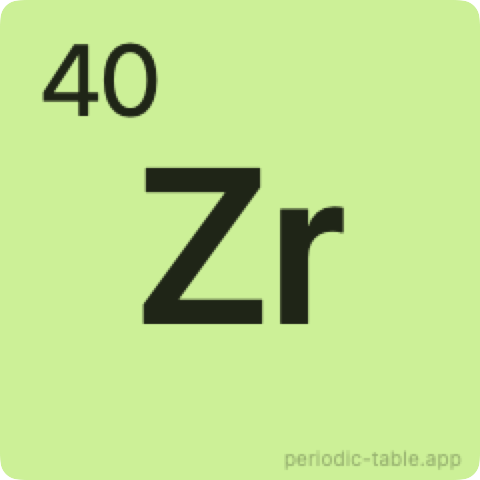
Zirconium
Zirconium is a silvery-gray transition metal valued for its resistance to corrosion. In nature it is bound in minerals rather than found as free metal. Its main source is zircon, recovered from mineral-rich sands, often alongside titanium ores. To obtain the metal, manufacturers convert zirconium compounds into a chloride and use magnesium to separate out the zirconium. Zirconium alloys form the protective tubes around fuel in many nuclear reactors: they resist corrosion under normal operating conditions and absorb few of the neutrons needed to sustain the nuclear reaction. For this use, the accompanying element hafnium must be removed because it absorbs neutrons strongly. Zirconium also has a sparkling connection: cubic zirconia, a form of the compound zirconium dioxide, is used as a diamond substitute in jewelry.
Atomic number
40
Group
IVB
Period
5
Mass
91.224
Latin name
Zirconium
Electron configuration
[] 4d² 5s²
Oxidation state
-2, 0, 1, 2, 3, 4
Download Chemistry application to view more information about the chemical element